
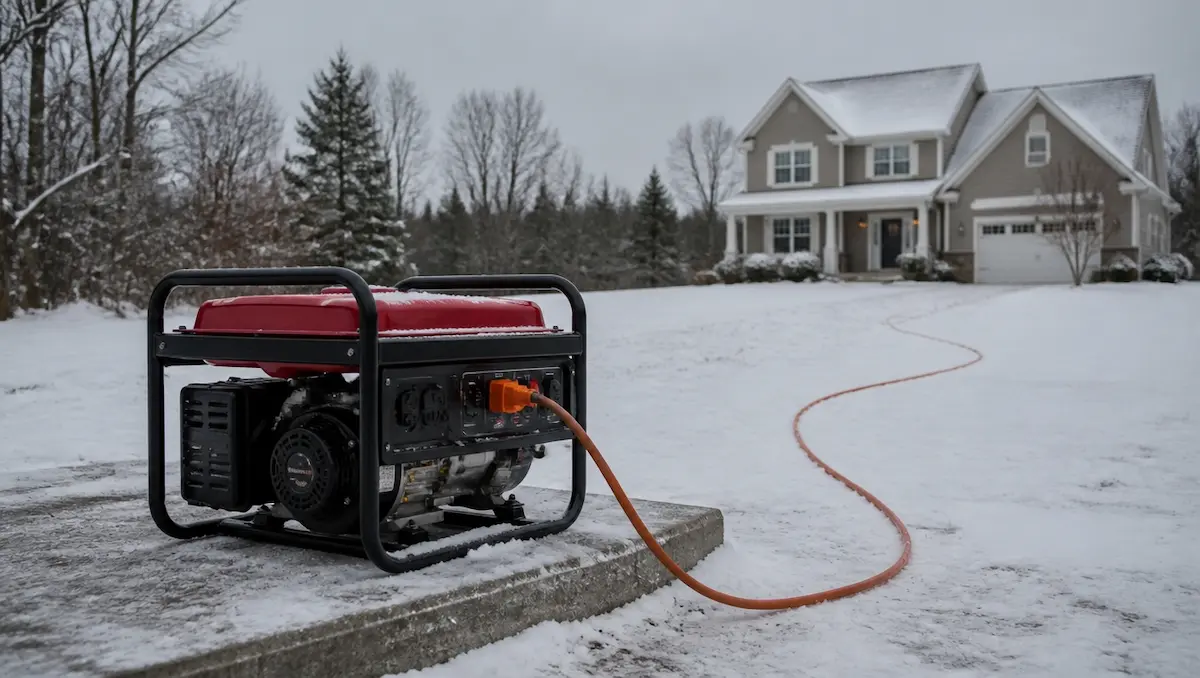
Run a portable generator outdoors, at least 20 feet from every door, window, and vent, and never in a garage, basement, crawlspace, or shed. That single rule prevents the most common cause of generator-related deaths in disasters: carbon monoxide poisoning.
The second rule matters almost as much. Never connect a generator to your home’s wiring without a proper transfer switch, because backfeeding can electrocute the line worker trying to restore your street.
Those two rules are the whole safety case in two sentences. The rest of this guide explains why they work, how much generator you actually need, how to size cords, and how to keep the machine running for three days without turning a manageable outage into a dangerous one.
Why 20 feet, and why distance alone is not enough
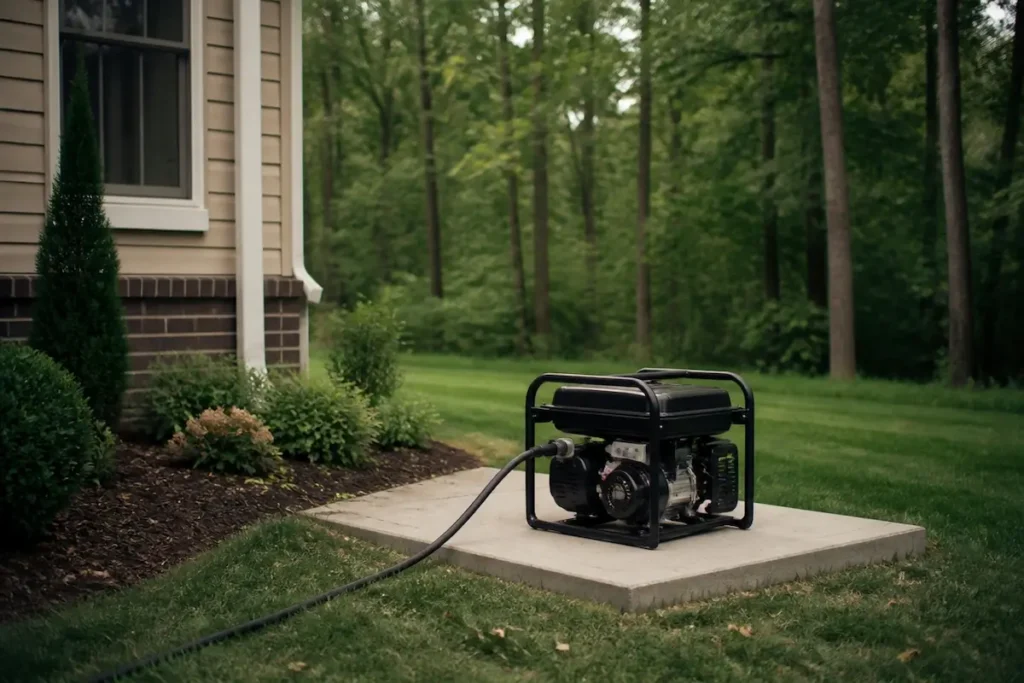
The 20-foot figure comes from the CDC and the Consumer Product Safety Commission, and it applies to doors, windows and vents, not just the front of the house.
The reason is air movement, not proximity. Generator exhaust contains carbon monoxide, which is colorless and odourless. If the generator sits near a wall, exhaust can eddy back against the building and be drawn in through a soffit vent, an open window, a dryer vent or a crack under a door. Twenty feet gives the exhaust room to disperse before it reaches an opening.
Three refinements make the rule work in practice.
Point the exhaust away from the building
A generator 20 feet away with its exhaust facing an open window is worse than one 15 feet away with its exhaust facing away.
Check the wind
On a still night, exhaust hangs. On a windy night, it can swirl. If you can smell exhaust inside the house, the placement is wrong, even if the setback measurement says you are compliant.
Twenty feet is a minimum, not a target
Farther is better, and placing the generator downwind and below the level of any opening is even better.
The most dangerous version of this mistake is the attached garage. People leave the door open, run the generator just inside, and assume the opening makes it safe. It does not.
CO from a garage enters the house through the adjoining wall, and it accumulates while people sleep. Every winter there are fatalities from exactly this setup.
Carbon monoxide: why it kills people who feel fine
Carbon monoxide binds to haemoglobin in the blood far more readily than oxygen does, so it displaces oxygen in the bloodstream even when the air still contains plenty of oxygen.
The symptoms arrive in a sequence that is easy to misread:
- A dull headache
- Nausea and a feeling of flu coming on
- Dizziness and weakness
- Confusion and poor judgement
- Drowsiness, then loss of consciousness
The dangerous feature is the middle of that list. Confusion and poor judgement arrive just when a person needs to recognize the problem and get out. People go to bed with a headache and do not wake up.
Children, older adults, pregnant women and anyone with heart or respiratory conditions are affected sooner.
What to do:
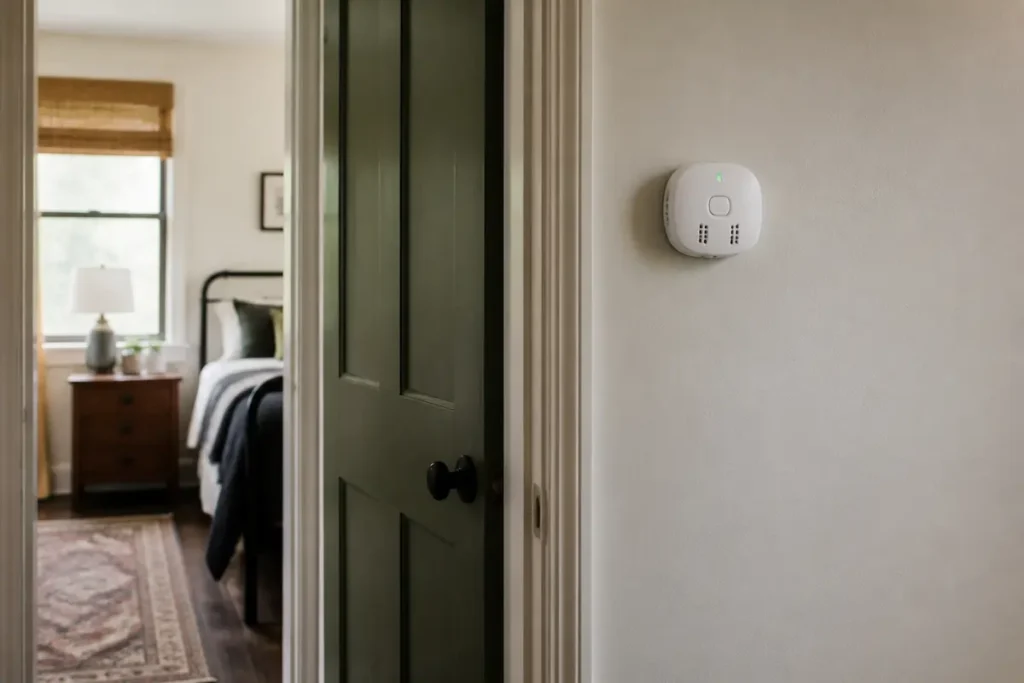
Fit CO alarms on each level of the home and near sleeping areas. Test monthly; replace according to the expiry date. A smoke alarm is not a substitute.
Never ignore a sounding CO alarm. Get everyone outside into fresh air, then call the fire service. Do not open windows and go back to bed.
Know the reset trap. If the alarm keeps sounding after you reset it, it’s doing its job. Shut the generator down.
Watch for the “I feel better outside” clue. If headaches clear when someone steps outside, that is the signature of CO in the building.
Wattage math that stops you tripping the generator
Generator sizing is where most people buy wrong, usually too small.
Two numbers matter on every appliance: running watts and starting watts. Running watts are what the appliance uses continuously. Starting watts are the surge when a motor starts, which can be two to three times the running figure for a fridge, freezer, furnace blower, or well pump.
To size a generator:
- List every appliance you want to run at the same time.
- Add their running watts.
- Add the largest single starting surge to that total.
That gives you the minimum. Add a margin, because appliances draw more in cold weather and nameplate figures are approximate.
| Appliance | Running watts (typical) | Starting surge |
| Refrigerator | 150-250 | 800-1,200 |
| Chest freezer | 200 | 600-900 |
| Furnace blower (gas) | 300-500 | 700-1,000 |
| Well pump (1/2 hp) | 750 | 2,000-2,500 |
| Sump pump (1/3 hp) | 800 | 1,300 |
| LED lights (10 bulbs) | 100 | 100 |
| Laptop and router | 100 | 100 |
| Phone charging | 10 | 10 |
| Microwave | 1,000 | 1,000 |
| Space heater | 1,500 | 1,500 |
| Window air conditioner | 1,200 | 2,200 |
These are typical figures, not specifications. Check your own appliance labels; the difference between a modern fridge and an old one is large.
A worked example for a winter outage, essentials only: refrigerator 200 + freezer 200 + furnace blower 400 + lights 100 + router 100 = 1,000 running watts, plus the largest surge, which is the fridge at 1,000.
That is 2,000 watts of headroom needed when the compressor starts. A 2,200-watt generator covers it with very little margin, which is why most households end up in the 3,000 to 7,500 running-watt range.
Two things that surprise people.
A bigger generator is not automatically better.
It burns more fuel, is louder, and is heavier to move. Overbuying wastes money and fuel during an outage when fuel is hard to get.
Space heaters and generators are a bad combination.
A single 1,500-watt heater can consume most of a small generator’s capacity, and running a generator to power resistive heating is an expensive way to stay warm. Fix the heat problem separately; keeping your home warm during a winter power outage covers that.
Three ways to connect a generator
Three common approaches exist, but only two are acceptable.
Extension cords to individual appliances
Run heavy-duty outdoor-rated cords from the generator’s outlets directly to appliances. This is the simplest safe method and the one most people should use.
The limits are practical. You cannot reach every circuit in the house; you have to run cords through doorways carefully, and you must not exceed the generator’s outlet rating. But nothing is connected to your home’s wiring, so the risks are limited to cord capacity and CO.
A transfer switch
A transfer switch is a dedicated panel, manual or automatic, that lets selected circuits run from the generator and physically prevents the generator from feeding back into the utility lines. A licensed electrician installs it, usually with a small sub-panel for the circuits you want backed up.
Manual transfer switches are the budget option: you start the generator, then throw the switch. Interlock kits are a cheaper variation that mechanically prevent the main breaker and the generator breaker from being on at the same time.
This is the correct long-term answer for a house. It costs money, and it is the only way to safely power fixed wiring.
Backfeeding through an outlet
This means connecting a generator to a house circuit, usually by making a male-to-male cable and plugging one end into a dryer, range or welder outlet. It is sometimes called a suicide cord, and the name is not hyperbole.
The problems are threefold. It energises wiring that should be dead, including the service lines outside the house, which can kill a utility worker. It bypasses normal breaker protection so a circuit can overheat without tripping. It can also backfeed a transformer and raise street voltage.
Never do this. If someone tells you it is fine because they did it for years, they were lucky.
Cord sizing and routing
A generator is only as good as the cord carrying its power.
Cord capacity is set by the wire gauge and the length. Thicker wire and shorter runs carry more current with less voltage drop and less heat.
| Gauge | Typical rating | Practical use on a generator |
| 16 AWG | 10-13A | Lights and phone chargers only; avoid for heaters |
| 14 AWG | 15A | Lights, router, small electronics, up to 25-50 ft |
| 12 AWG | 20A | Refrigerator, freezer, furnace blower, up to 50 ft |
| 10 AWG | 30A | Heavy loads, transfer switch feed, short runs |
Three rules for cords:
- Use outdoor-rated cords for anything that leaves the house, and never run a cord through a doorway where the door can pinch it or a window where the frame can cut it.
- Keep connections dry. Elevate the plug connections off wet ground, or use a purpose-made connection cover. Water plus 120 volts is not a survivable combination.
- Do not coil a cord that is carrying a heavy load. A coiled cord cannot shed heat. Lay it out.
Length matters as much as gauge. A long thin cord causes voltage drop, which makes motors work harder and run hotter. If the run is more than about 50 feet, go up a gauge rather than adding another cord in series.

Fuel: storage, rotation and the refuelling rule
Fuel handling causes more generator fires than electrical faults.
Never refuel a hot generator. Shut it down and let it cool before opening the cap. Gasoline on a hot exhaust or engine block ignites readily, and the tank sits directly above the heat.
Store fuel only in approved containers, outdoors or in a detached shed—never in a basement or utility cabinet, and never near the running generator.
Do not store more than you need. Fuel degrades, and a large stock of gasoline is a fire load. For a three-day outage, most households need 10 to 20 gallons, depending on load and generator size.
Rotate your stock. Gasoline begins to degrade within a few months. Use a fuel stabiliser, date the containers, and cycle the fuel into the car rather than letting it sit for years.
Consider ethanol-free fuel for small engines, which stores better and causes fewer carburettor problems. This is more of a maintenance issue than a safety one, but it is the difference between a generator that starts in year three and one that doesn’t.
Run the carburettor dry before long storage. Many generators have a fuel shut-off valve for exactly this purpose.
Weather protection without enclosing it
Generators need to run outdoors, and they also need to stay dry. Those two requirements conflict, and people resolve the conflict badly.
Do not box the generator in. A tarp draped over it, a plywood enclosure, or a run-in shed traps carbon monoxide and heat. Carbon monoxide builds up under a tarp just as effectively as in a garage.
Use a purpose-made generator tent or canopy if you need weather protection. These are designed to vent exhaust while keeping rain off the panel and outlets.
Place it on a raised, dry surface. Concrete or a pallet, not wet grass or a puddle. Standing water plus electricity is the other way generator users get hurt.
Keep it out of snow drifts. Exhaust outlets buried in snow can cause the engine to run poorly and force exhaust back toward the house.
Do not run it on a balcony, a porch, or against a wall where exhaust has nowhere to go. Apartments and balconies are covered separately in generator use in an apartment.
Grounding, GFCI and shocks in wet conditions
Portable generators have specific grounding requirements that differ by model.
Follow the manufacturer’s instructions for your unit. Some generators require a grounding rod; many modern portable units with a floating neutral do not, and incorrect grounding creates its own hazard. If the manual is unclear, ask an electrician rather than guessing.
Use outlets with ground-fault protection where available. Many modern generators include GFCI outlets, which trip when current leaks to ground, protecting people from shock in wet conditions. If yours does not, a GFCI-protected cord set is a reasonable addition.
Keep your hands dry, stand on a dry surface, and never touch the generator’s frame and a wet appliance at the same time. Sounds obvious, and it is still how people get hurt.
Maintenance that prevents the 2am failure
A generator that will not start at 2am in a storm is a decoration. Five things keep it reliable.
Exercise it monthly under load. Run it for 20 to 30 minutes with something plugged in, not just idling. This keeps seals lubricated, burns off moisture, and proves it works.
Change the oil on the schedule in the manual. Small engines have a short oil interval, and the first change is usually early.
Check the air filter. A clogged filter causes hard starting and rich running.
Replace the spark plug at the interval, and keep a spare with the generator.
Treat fuel as the top suspect. Most no-start problems are stale fuel or a gummed carburettor. Rotate your fuel, use stabiliser, and run the carburettor dry before storage.
Add a small spares kit: a spare spark plug, a funnel, oil, a flashlight, and the manual in a ziplock bag. During an outage, none of those are available locally.
Running a generator safely for several days
Long outages introduce problems that a one-night outage does not.
Fuel resupply becomes the risk. Store enough for 48 hours and know where the next supply is. Do not drive around with loose containers.
Rotate what is running. You don’t need the freezer running all night. Run the heavy loads in blocks and let the generator rest.
Watch the oil. Continuous running consumes oil. Check it daily, engine off, on a level surface.
Keep the area clear of snow and water, and re-check the 20-foot distance if drifting snow changes the layout.
Re-check CO alarms. Long-running means sustained exposure risk. Test them and make sure nobody has “just cracked a window” as their only mitigation.
Do not bring the generator in when it gets really cold. This is the single worst decision people make during a winter outage. Cold is uncomfortable; CO is fatal. Add clothing, close off rooms, and keep the generator outside.
When the power comes back
Shut the generator down before reconnecting to utility power, and if you have a transfer switch, switch back in the correct order. Let the generator cool, then store it with fuel treated and the carburettor run dry.
Then review it while it is fresh: how much fuel did you use, what ran out first, and what didn’t work? The next outage will be easier because of five minutes of notes.
Inverter or conventional: the difference that matters at night
Most buyers compare wattage and price and skip a distinction that affects both noise and how safely the power suits modern equipment.
Conventional generators run the engine at a fixed speed, usually 3,600 rpm, and produce power directly. They cost less for a given wattage, but they are heavier and louder. The output is a fairly rough sine wave, which older appliances tolerate and sensitive electronics sometimes do not.
Inverter generators produce power electronically and vary engine speed with load. They are quieter, more fuel efficient at light loads, lighter for the same output, and produce a cleaner waveform. They cost more.
For an outage with a fridge, a furnace blower, and a few lights, either works. For charging laptops, running a modern boiler with electronic controls, or powering medical equipment, an inverter unit’s cleaner output is worth the premium.
Noise is not just comfort. A generator running all night 20 feet from a neighbor’s window can be a real source of complaints, and some local ordinances set noise limits for residential areas. Inverter units are markedly quieter at part load, which is where they spend most of an outage.
Fuel efficiency matters too. An inverter generator running at quarter load uses far less fuel than a conventional unit of the same rating, and during a multi-day outage, the fuel you don’t burn is the fuel you don’t have to wait in line for.
If the generator stops mid-outage
It will happen at the least convenient moment. The diagnostics are usually straightforward.
Engine turns over but will not start. Check the fuel valve, the choke position, and the oil level. Many units have a low-oil shut-off that prevents starting. If it has been sitting, stale fuel is the most likely cause.
Starts then dies. Often the same low-oil sensor, or a blocked fuel cap vent. Loosen the cap briefly; if it runs, the vent is blocked.
Runs but nothing is powered. Check the breaker on the generator’s panel, then the cord, then the appliance. A tripped generator breaker after a surge is normal; reset it once and see whether it holds.
Surges or flickers when a large appliance starts. You are near the surge limit. Shed a load before starting the motor.
Overheats and shuts down. Check airflow, oil level, and cooling fins for blockages. Shut it down, let it cool, clean the intake, and restart.
Keep the generator manual in a plastic bag, and write the oil type on the storage box lid. During an outage, you will not want to look any of that up on a phone with 8 percent battery.
Frequently asked questions
How far should a generator be from the house?
At least 20 feet from doors, windows, and vents, outdoors only, with the exhaust pointed away from the building. Farther and downwind is better.
Can I run a generator in my garage with the door open?
No. A garage is an indoor space, and carbon monoxide accumulates faster than an open door clears it. It also enters the house through the adjoining wall.
What size generator do I need?
Add the running watts of everything you want on at once, then add the largest starting surge. Most homes need 3,000 to 7,500 running watts for essentials.
Can I plug a generator into my dryer outlet?
No. That is backfeeding. Without a transfer switch, it can energise utility lines and injure workers, and it bypasses your home’s breaker protection.