

A portable space heater needs three feet of clear space on every side and its own wall outlet, with no extension cord or power strip. Those two requirements prevent most heater fires, and neither one costs anything.
The failures that do happen are rarely dramatic equipment faults. They are a sweater left on a chair inside the three-foot zone, a cord that has been quietly overheating behind a sofa for two winters, or a unit bought for a bedroom and placed against a curtain because the room was small.
Below are twelve rules, each with the reason behind it, so the rules stick. There is also the electrical math most articles skip, because a heater that trips the breaker is telling you something worth understanding.
Rule 1: Give it three feet on every side
The US Consumer Product Safety Commission’s guidance for portable heaters is three feet of clearance from anything that can burn, on all sides. Not just the front where the grille points.
In a bedroom, that zone includes bedding, curtains, the edge of the mattress, clothes on a chair, books, paper and the rug. In a living room, it includes the sofa, throws, magazines and the Christmas tree if it is that time of year.
A practical way to check: stand where the heater sits and hold your arm out. If you can touch something soft or flammable within arm’s reach, it is too close.
The reason is convection, not just contact. Heaters push hot air upward. Fabric draped above or beside a heater continuously absorbs that hot air, and cotton or polyester ignites at a lower temperature than people assume. A towel over the back of a chair beside a heater is a genuine risk.
If a room is too small to give the heater three feet, it’s too small for that heater. Use a smaller unit with a lower output or heat the room another way.
Rule 2: Plug it straight into the wall
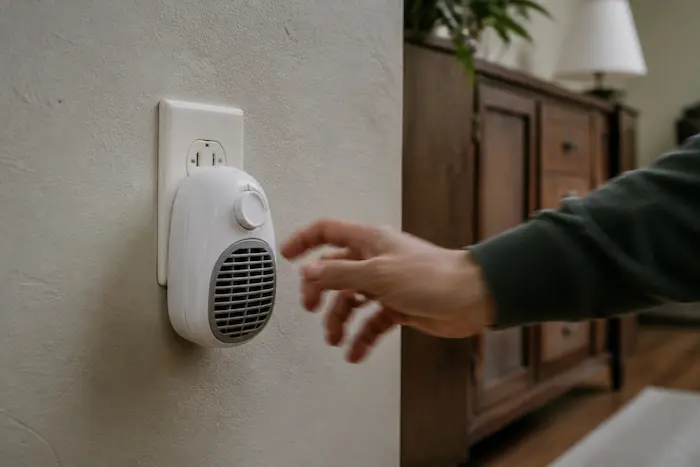
No extension cord. No power strip. No multi-plug adapter. Straight into the wall outlet.
The manufacturer includes this instruction for a reason, and the CPSC repeats it. A space heater is one of the few household appliances that draws high current continuously for hours, not in short bursts. Cords and strips are rated for short-term loads, and the connections inside them are the weak point.
There is also a mechanical problem. Plugs work loose in power strips over time, and a loose plug causes arcing, which means heat in a place you cannot see, usually behind furniture.
If the cable will not reach the outlet, move the heater or have an electrician fit an outlet where you need one. Do not solve it with a cord.
If you genuinely must use a heavy-duty cord for a very short period, the only defensible version is a single-outlet, 12-gauge or thicker outdoor-rated cord, fully uncoiled, with nothing else on it. Even then, it is a compromise, not a solution. Most manufacturers simply say no.
Rule 3: Do the wattage math once
This is the part people skip, and it explains most tripped breakers.
A typical portable electric heater is rated 1,500 watts. On a standard US 120-volt circuit, that is 12.5 amps.
A standard household circuit is 15 amps. Electrical code treats a load that runs for three hours or more as continuous, and continuous loads are limited to 80 percent of the circuit rating. Eighty percent of 15 amps is 12 amps.
So a single 1,500-watt heater, running on its own outlet with nothing else on the circuit, is already at the limit. Add a lamp, a phone charger, a television or a hair dryer on the same circuit, and you are over it. The breaker trips because it is doing its job.
| Heater type | Typical setting | Watts | Amps at 120V | Circuit headroom |
| Small ceramic, low | Low | 750 | 6.3 | Comfortable on 15A |
| Ceramic tower | High | 1,500 | 12.5 | At the limit on 15A |
| Oil-filled radiator | High | 1,500 | 12.5 | At the limit on 15A |
| Infrared patio-style | High | 1,500 | 12.5 | At the limit on 15A |
| Mica panel | High | 1,000 | 8.3 | Fine on 15A |
Check the label on the back or underside of your unit. The wattage is printed there, and it is the only figure that matters. Marketing terms like “eco mode” describe a lower setting, not a more efficient heater.
Two practical consequences follow.
First, run the heater on low where possible. A 750-watt setting gives you room to run a lamp on the same circuit.
Second, find out which outlet is on which circuit. In most homes, all the outlets in one room and part of the next share a breaker. If your heater trips the breaker whenever the kettle boils, they are on the same circuit, and you need to move one of them.
Rule 4: Know why extension cords fail
The rule is easy to follow—and easy to break—when the only free outlet is behind the sofa. Understanding the failure makes it stick.
Every cord has resistance. When current flows through resistance, the cord warms up. A cord sized for a lamp has thin conductors and higher resistance. Put 12.5 amps through it and the warmth becomes heat, concentrated at the plug and the outlet where the connection is least perfect.
Cheap extension cords also use thinner copper than their packaging implies. A cord rated “13 amps” may hit that rating only in free air at room temperature, not coiled behind a sofa under a rug where heat cannot escape.
Coiled cords are the worst case. A coil of warm cable cannot shed heat, so the inner turns get hotter than the outer ones. This is why an extension cord left coiled on a carpet and covered with a cushion is a genuine fire risk.
Signs of trouble are worth knowing: a plug that feels warm to the touch, a discolored outlet, a faint burning smell, or a cord that has become stiff. Any of those means stop using it.
Rule 5: Place it for the room, not just the floor space
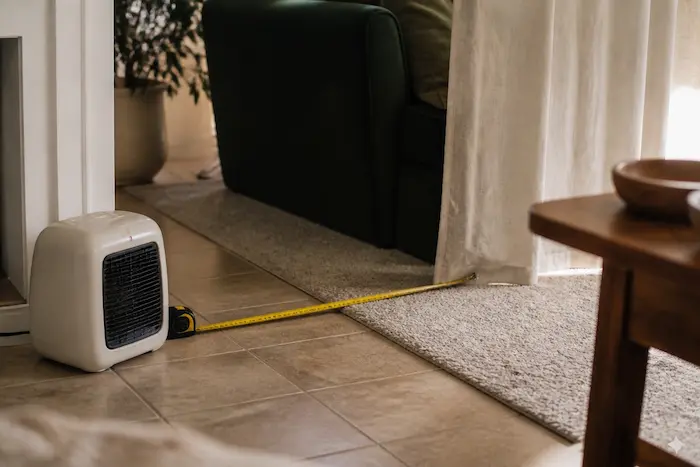
Placement changes both safety and comfort. A heater in the wrong spot runs longer and does less.
Bedroom. Keep it at least three feet from the bed, and further from anything that could fall on it. Do not place it where bedding can slide off the mattress onto the unit overnight. Put it on a hard, level floor, not on carpet if the manufacturer warns against it, and not on a stool or box where it can be knocked off.
Bathroom. Only if the unit is rated for damp locations, and only on an outlet protected by a ground-fault circuit interrupter. Never within reach of the bath or shower, and never on the edge of a wet floor. Most manufacturers advise against bathroom use entirely, and a wall-mounted bathroom heater is the better answer.
Children’s rooms and pets. Assume a child will touch it. Choose a unit with cool-touch housing and a tip-over switch, keep the cable out of reach, and don’t rely on “it is hot, they will learn”. A gate or a fixed position behind furniture is more reliable than instruction.
Workshops and garages. Cold floors, sawdust and solvents change the risk. Keep it clear of sawdust, never use it near paint or solvent fumes, and check that the unit is rated for the space. Garage heaters often need to be hard-wired or rated for outbuildings.
Anywhere. Never in a doorway, never on a staircase landing where someone will trip over the cable, and never in a room where the door is kept closed with the unit running unattended.
Rule 6: Use the safety features, and test them
Most modern heaters have a tip-over switch and an overheat cut-out. Both are worth having, and neither is worth trusting until you have checked it.
Test the tip-over switch once a season. With the heater running on a hard floor, tip it gently onto its side and confirm it switches off. If it keeps running, return it or stop using it.
The overheat cut-out is harder to test deliberately, but you should know what it does: it cuts power when internal temperature rises too far, usually because the intake or exhaust is blocked. Keep both grilles clear of dust and fabric. A heater pushed against a curtain is not just a fire risk; it will shut down repeatedly.
Look for a recognized safety mark on the unit or its packaging, such as UL or ETL. That mark means the product was tested to a standard, not that it is safe in any position, but it is the minimum bar.
Rule 7: Never leave it running unattended
“Unattended” means you are asleep, out of the house, or in another room for a long stretch.
If you must leave it on in an empty room, keep it on for a short period, with nothing within three feet, on a hard floor, plugged directly into the wall, and on a timer if the unit has one.
The uncomfortable truth is that heater fires often start while people are in the house. The unit is on in the bedroom, someone falls asleep, a throw slips off the bed. Unattended use simply removes your ability to react.
For overnight use specifically, see rule 9.
Rule 8: Fuel heaters are a different risk entirely
Kerosene and propane heaters do not just get hot. They produce carbon monoxide and water vapor, and they consume oxygen from the room.
If you use one, the requirements change: a working carbon monoxide alarm in the same room or adjacent hallway, some ventilation as specified by the manufacturer, correct sizing for the room volume, and never in a bedroom or bathroom unless the unit and your local code explicitly allow it.
That topic deserves its own treatment, and it has one: indoor propane heater safety covers vent-free units, room-size math and cylinder handling in detail. Read it before buying a fuel heater, not after.
The one rule worth repeating: never use a camping stove, barbecue, or patio heater indoors, and never run a portable generator inside a building or a garage. Those kill people every winter, and they kill quietly.
Rule 9: Decide the overnight question honestly
Can you leave a space heater on overnight? The safe answer is a conditional yes, and the conditions are strict.
Yes, if all of the following are true:
- The unit has a tip-over switch and a thermostat, and you have tested the switch.
- It sits on a hard, level floor with three feet clear on every side, including above.
- It is plugged directly into a wall outlet with nothing else on that circuit.
- Nothing can fall onto it, and no bedding, curtain or clothing is within the zone.
- You are in the same room, and the door is not sealed with the unit running in an enclosed space.
No, if any of those is false.
A middle path many people use: warm the bedroom for an hour before sleep, switch off the wall heater, and rely on bedding and a warm room. A hot water bottle or an extra duvet does the rest with no electrical risk at all. It is less comfortable than a heater running all night, and it is meaningfully safer.
If you are heating a bedroom because the house is cold, it is also worth understanding why. A draft under a door or through a window frame is cheaper to fix than to heat against, which is what the guide to insulating windows for winter covers.
Rule 10: Watch the plug, the outlet and the cable
Three hardware checks, once a month, take under a minute.
Feel the plug after an hour of use. It should be no more than slightly warm. A hot plug means a poor connection or an undersized circuit.
Look at the outlet. Brown discoloration, a scorch mark, or an outlet that grips the plug loosely are all reasons to have an electrician look at it before you use it again.
Look at the cable. Kinks, cracks, a flattened section where a door has closed on it, or a repair with insulating tape are all reasons to retire it. Cables are not repairable.
Also look at the grilles. Dust build-up on the intake is the most common cause of an overheat cut-out, and it is the easiest thing in this article to fix.
Rule 11: Keep it away from water and wet hands
Electricity and water are the obvious hazard. The less obvious one is condensation.
A heater in a cold garage or an unheated conservatory can develop condensation inside its casing when it warms up. Let it come to room temperature before use if it has been stored somewhere cold, and never operate it with wet hands or while standing on a wet floor.
In kitchens and bathrooms, the outlet location matters more than the heater. If the only outlet is within splashing distance of a sink, the heater does not belong there.
Rule 12: Size the heater to the room, not to the shop display
A bigger heater is not a better heater. A 1,500-watt unit in a small, well-sealed bedroom will cycle on its thermostat and heat the room quickly. The same unit in a large, drafty living room will run continuously, never quite keep up, and cost more to run than a smaller unit in a smaller space.
Two things help more than a bigger heater: stopping the drafts, and heating the room you are actually in rather than the whole house. Closing doors, using a door draft excluder and hanging a heavier curtain all reduce the heat the heater has to replace.
There is also no efficiency trick to buy. All electric resistance heaters convert electricity to heat at essentially the same rate. A 1,500-watt ceramic heater, a 1,500-watt oil-filled radiator and a 1,500-watt panel all deliver the same heat for the same electricity. What differs is how the heat is distributed, how noisy the unit is, and how safe it is to touch. Anyone selling “energy-saving” electric heating is selling a lower wattage setting under a different name.
The 60-second pre-season check
Before the first cold night, run through this once.
- Read the label and confirm the wattage and the model’s clearances.
- Inspect the cable and plug for damage.
- Vacuum the intake grille.
- Plug it into a wall outlet on a circuit with nothing heavy on it.
- Run it on low for ten minutes and check the plug temperature.
- Tip it over and confirm the cut-out works.
- Confirm the smoke alarm and carbon monoxide alarm both work, especially if any fuel appliance is in the house.
That is the whole ritual. It takes a minute, and it catches the failures that cause most winter incidents.
If something goes wrong
If the breaker trips repeatedly, stop using that outlet. Either the circuit is overloaded, or the heater is faulty. Move the heater to a circuit with headroom; if it still trips, the unit is the problem.
If you smell burning dust on first use, that is normal for a new element and fades within an hour. If you smell burning plastic or an acrid, chemical smell, switch it off at the wall and stop using it. That smell is insulation or housing overheating.
If the heater sparks, crackles or the plug discolours, stop immediately and have it checked. Do not fix it up and carry on.
If a fire starts, get out, close the door behind you, and call the fire service. Do not fight a fire that is spreading through fabric. Portable heater fires grow fast because the fuel is soft furnishing.
If someone shows signs of carbon monoxide exposure from a fuel heater — headache, nausea, dizziness, and confusion — get them outside into fresh air and call for help. Do not go back inside to open windows first.
Five myths that start fires
A few beliefs cause a disproportionate number of winter incidents. Each one sounds reasonable.
“It has a thermostat, so it can run all night.”
A thermostat controls temperature, not clearance. The unit still needs three feet, and it still needs to be on a hard floor with nothing draped over it. Thermostats prevent overheating, not ignition of nearby fabric.
“The cord is heavy duty, so it is fine.”
Heavy duty is a marketing phrase. The only numbers that matter are the gauge and the length, and even a correctly sized cord adds a failure point between the wall and the heater. Manufacturers still say no.
“I only use it while I am in the room.”
Most heater fires start while someone is in the room, usually asleep or distracted. Presence is not supervision.
“It is safer on a low setting.”
Lower wattage reduces circuit strain, which is genuinely useful. It does not reduce the fire risk from a towel falling onto the grille, because the element and housing still get hot.
“Ceramic is safer than coil.”
Housing design matters more than element type. Either can be safe in the right position and dangerous in the wrong one. Look for a cool-touch housing and a tested tip-over switch rather than a particular technology.
A word on electric blankets and throws
If the goal is a warm bed rather than a warm room, a heated blanket or throw uses far less power than a space heater and carries a different risk profile.
The trade-off is worth understanding. A heated throw draws tens of watts rather than 1,500, so it costs almost nothing to run and does not stress a circuit. The risks are different: flexing cables inside the blanket, age, and use by people who cannot feel heat properly.
Replace any blanket with a frayed cable, a scorch mark, or a controller that flickers. Do not use one on a hospital-style adjustable bed where the blanket can be compressed or creased repeatedly. Do not use one for a baby or for anyone who cannot feel or communicate discomfort, including some older adults and people with diabetes or reduced sensation.
For many people, a heated throw plus a warm duvet is a better answer to a cold bedroom than a space heater, and it removes the overnight question entirely.
Frequently asked questions
Can I leave a space heater on overnight?
Only with a tested tip-over switch, a thermostat, three feet of clear space, a hard floor, and a direct wall outlet. If any of those is missing, warm the room before bed and switch the heater off.
Can a space heater run on an extension cord?
No. A 1,500-watt heater draws close to the continuous limit of a standard circuit, and cords add resistance and heat at the plug. Use the wall outlet.
Do ceramic heaters use less electricity?
No. All resistive electric heaters turn electricity into heat at essentially the same rate. A 1,500-watt ceramic unit costs the same to run as a 1,500-watt oil-filled one.
Why does my heater trip the breaker?
Usually because the heater alone is at the continuous limit of a 15-amp circuit and something else is sharing it. If it trips on an empty circuit, the unit or the wiring is faulty.
Sources
- US CPSC, Reducing Fire Hazards for Portable Electric Heaters
- US CPSC, Portable Electric Heater Safety Alert
- NFPA, Safety with heating equipment
- NFPA, Electric Portable Space Heater Safety tip sheet
- Appliance nameplate data (wattage table) — no public link