

Most water treatment in a modern home depends on electricity. A pitcher filter uses no power, but it removes little. A fridge filter needs the fridge. A reverse osmosis unit needs a pump. An ultraviolet purifier needs a bulb and a socket.
When the power fails, the water may keep running for a while, then stop too, because the utility’s pumps are electric. That’s when the question becomes practical: how do you make water safe to drink with nothing but gravity, fuel, or a few drops of bleach?
Three methods cover almost every household need without a watt of electricity: boiling, a gravity filter, and chemical disinfection. Each has strengths and limits, and the safest plan combines two.
This guide explains what each method actually removes, how fast it works, how to build a bucket system for very little money, and the mistakes that make people sick even when they think they are treating their water.
Why water is the first thing to fail
Water is heavier than food, harder to store, and needed sooner. A person can go weeks without food and only days without water, and in heat or during illness that margin shrinks fast.
Municipal water systems depend on pumps and pressure. During a wide outage, pressure drops, and when pressure drops, the utility issues a boil-water notice, because without pressure, contaminants can enter through cracks in aging pipes. That notice is the key detail: the water may still run, may still look clear, and may still be unsafe.
Private wells fail the moment the pump loses power, usually within the first minute of an outage.
So the plan has two parts. Store water you know is clean, and keep a way to treat water you do not trust. Storage is covered in detail in how much emergency water to store. This article is about the second part.
Filtering and purifying are not the same thing
People use the words interchangeably, but they shouldn’t.
Filtering removes physical material: sediment, rust, silt, and in better filters, cysts and some bacteria. A filter makes water clear.
Purifying or disinfecting kills or inactivates pathogens: bacteria, viruses and parasites. Disinfection makes water microbiologically safe.
Neither removes dissolved chemicals such as pesticides, heavy metals or salt, unless the filter is specifically rated for them.
Why the distinction matters
Cloudy water can clog a filter and shield pathogens from disinfectant, so the correct order is usually filter first, then disinfect. And a filter alone does not make questionable water safe to drink, because the smallest pathogens—viruses—are small enough to pass through many filter pores.
There are three categories of contaminant that matter:
| Contaminant | Size | Killed by boiling | Removed by ceramic filter | Removed by carbon |
| Protozoan cysts (Giardia, Cryptosporidium) | 4 – 10 microns | Yes | Yes | No |
| Bacteria (E. coli, Salmonella) | 0.2 – 2 microns | Yes | Mostly | No |
| Viruses (norovirus, hepatitis A) | 0.02 – 0.3 microns | Yes | Often not | No |
| Sediment and silt | Larger than 10 microns | No | Yes | Partly |
| Dissolved chemicals and metals | Molecular | No | No | Some |
| Salt | Molecular | No | No | No |
The practical conclusion is uncomfortable for filter sellers: boiling is the only method on that table that handles every pathogen category, and it is free if you have fuel. A filter is a convenience and a clarifier. A filter plus disinfection is a system.
Boiling: still the gold standard
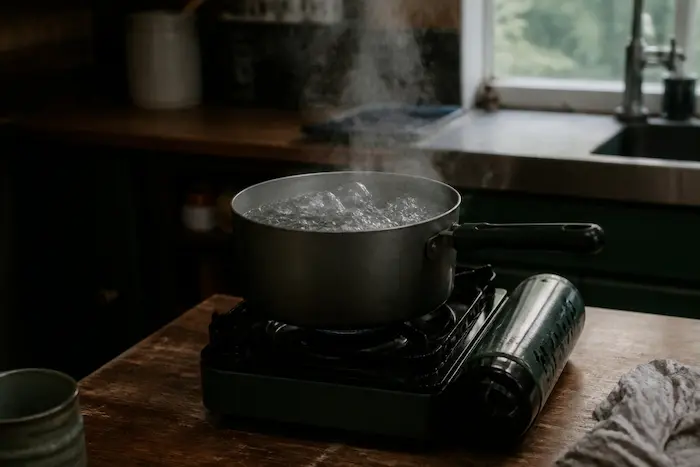
Bring water to a rolling boil for one minute, and let it cool. That is the whole method. At elevations above about 6,500 feet, boil for three minutes.
Boiling kills bacteria, viruses, and parasites. It does not remove sediment or chemicals, and it does not improve the taste of water that has been sitting in a warm container. It also slightly concentrates dissolved minerals as water evaporates, which matters only in extreme cases.
Three practical points people get wrong.
You do not need to boil for ten minutes. Older guidance said so, and it wastes fuel. The current recommendation from the CDC and the EPA is one minute at a rolling boil.
Boiling does not require a special pot. Any clean metal pot works. A kettle works. A camping stove works.
Fuel is the real constraint. Boiling one gallon takes a meaningful amount of fuel, and in a long outage, fuel becomes scarce. That is why boiling is the right answer for small volumes, such as drinking water for one or two people, and a poor answer for washing water or for a family of six over a week.
If you are boiling, boil in batches, keep a lid on the pot, and store the cooled water in clean containers rather than re-boiling later.
Gravity ceramic and carbon filters
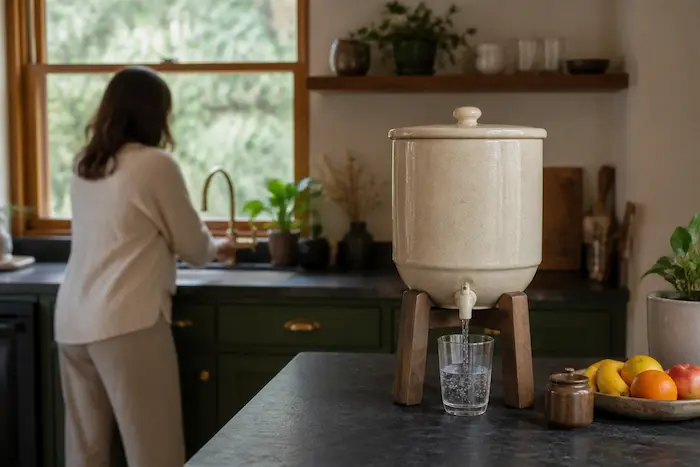
A gravity filter sits on a counter; you fill the top chamber, and water drips through a ceramic element and often a carbon block into the bottom chamber. No power, no noise, no moving parts.
What they remove: sediment, cysts, most bacteria, and, with a carbon stage, chlorine, taste, and some organic chemicals. They excel at making stored or cloudy water palatable and biologically safer.
What they do not remove: viruses reliably, dissolved salts, and most dissolved metals.
Flow rate is the honest limitation. A typical household gravity unit produces roughly one to three quarts per hour depending on the model and how clogged the ceramic is. That is fine for drinking water for two people. It is not enough for a family that cooks and washes.
Maintenance matters more than the brand. Scrub the ceramic element when flow slows, and replace it at the manufacturer’s interval. A filter that has been sitting dry in a garage for three years is not a filter; it is a decorative object. Ceramic elements can also crack if dropped or frozen, and a cracked element lets everything through while still looking intact.
Storage: keep the unit assembled and dry, keep spare elements with it, and store the whole thing where you can find it in the dark.
A gravity filter is the right purchase for a household that wants one quiet appliance that works every day, not just in emergencies. Its value in an outage is that it is already set up.
Straws, squeeze filters and pump filters
Hollow-fiber filters come as drinking straws, inline squeeze bags, and hand pumps. They work by forcing water through fine fibers under pressure from your mouth or hand.
What they remove: bacteria and cysts very well, sediment well, viruses poorly to moderately depending on the model.
What they are good for: personal drinking water on the move, bug-out bags, hiking, and single-person needs.
What they are bad at: volume. Filling a pot for cooking with a straw filter is miserable. They also clog with turbid water, and they fail in freezing conditions if water is left inside the fibers, which cracks them.
Renters and small flats find these useful as a compact backup that takes up a drawer rather than a counter.
If you buy one, buy two. They are small, they fail without warning, and a spare costs far less than a day without drinking water.
Bucket drip systems you can build
This is the highest-value system for a household on a budget, and it is easy to assemble.
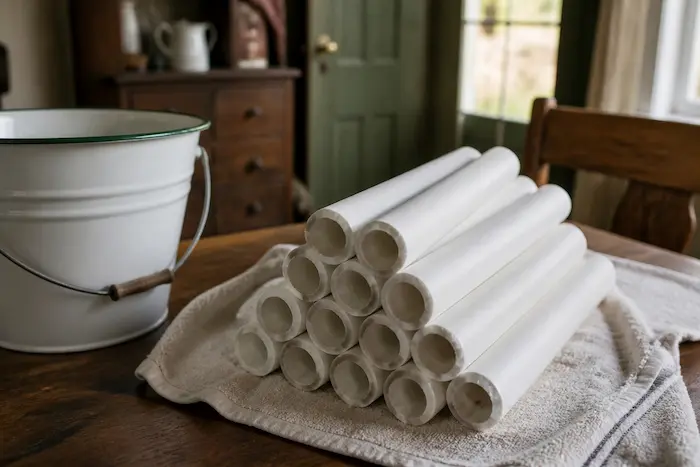
Two food-grade buckets, one nested above the other, with a filter element between them. Water goes in the top, drips through the filter, and collects in the bottom with a spigot.
Parts list:
- Two 5-gallon food-grade buckets with lids
- One ceramic candle filter element, or a purpose-made bucket filter kit
- A spigot for the lower bucket
- Food-grade tubing if the kit requires it
- A drill for the hole, or a kit that comes pre-drilled
Assembly: drill the lid of the lower bucket to accept the filter element, mount the element, seat the upper bucket on top, install the spigot low on the lower bucket, and keep the whole thing out of direct sunlight.
Output: roughly one to two quarts per hour per element, so two elements double the rate. For a family, that is a working day to produce a day’s drinking water, which is why you fill it before you need it, not after.
Cost: by far the cheapest route to serious filtration. A two-bucket system with a quality ceramic element costs less than a mid-range countertop unit.
Hygiene: clean the buckets with soap and water before first use, never put anything but water in the upper bucket, and scrub the ceramic when flow drops. Do not let the lower bucket sit full for weeks; use it and refill it.
This is the system I would build first, and it’s worth building before a storm rather than during one.
Chemical disinfection, with the actual numbers
Chlorine bleach is the most widely available household disinfectant, and it works if you use the right concentration and amount.
Use plain unscented household bleach with a sodium hypochlorite concentration stated on the label, typically between 5 and 9 percent. Do not use splashless, scented, or color-safe bleach, and do not use bleach that has been sitting open for a year, because it loses strength.
The dose. For clear water at roughly 5 to 6 percent sodium hypochlorite, the common guidance is about 2 drops per quart, or 8 drops per gallon, or a scant half teaspoon per 2 gallons. Double the dose for cloudy water, and let it stand for 30 minutes. If you cannot smell chlorine after 30 minutes, repeat the dose and wait another 15 minutes.
What it kills: bacteria and viruses well. It is less reliable against Cryptosporidium, which is why boiling or filtration is preferred when crypto is a concern.
What it does not do: clear cloudy water, remove chemicals, or improve taste. Filter first, then dose, or the chlorine gets consumed by the dirt instead of the germs.
Iodine tablets work and are convenient, but they are not suitable for pregnant women, people with thyroid conditions, or for long-term use.
Storage and shelf life: bleach degrades. Rotate it annually, and date the bottle when you buy it.
Write the dose on a card and tape it inside the cupboard where the bleach lives. In an outage, nobody wants to be doing arithmetic by torchlight.
Solar disinfection and its limits
Solar disinfection, usually called SODIS, uses sunlight and clear plastic bottles. Fill a clear PET bottle with filtered water, shake it to oxygenate, and leave it in full sun for at least six hours, or two days if the sky is overcast.
It works, it costs nothing, and it has serious limits. It needs strong sun and clear water, treats only small volumes, and does nothing in winter at high latitudes or under heavy cloud. The bottles must be clear, not colored, and scratched bottles work poorly.
Treat SODIS as a backup for sunny climates when fuel and chemicals run out. It is not a plan for a household in November.
What fails when the power goes out
Be clear about which devices stop working so you don’t count on them.
| Device | Needs power | Works in an outage |
| Pitcher filter (Brita style) | No | Yes, but removes little beyond taste and some chlorine |
| Fridge dispenser filter | Yes | No |
| Under-sink reverse osmosis | Yes, pump | No |
| UV purifier | Yes, bulb | No |
| Countertop gravity filter | No | Yes |
| Hollow-fiber straw | No | Yes |
| Bucket drip system | No | Yes |
| Electric kettle | Yes | No, use a stovetop or camp stove |
| Water softener | Yes | No, and it may bypass |
The pattern: anything with a pump, a bulb or a solenoid fails. Gravity and chemistry keep working.
Matching the method to the situation
| Situation | Best first choice | Backup |
| Boil-water notice, taps still running | Boil, or gravity filter plus boil | Bleach dosing |
| Well pump out, no water at all | Stored water, then refill from a safe source and treat | Bucket filter plus bleach |
| Cloudy flood water | Settle, filter, then boil | Filter then bleach, double dose |
| Short trip or bug-out bag | Squeeze filter or straw | Iodine tablets |
| Long outage with limited fuel | Bucket drip filter plus bleach | SODIS if sunny |
| Chemical contamination suspected | Do not drink it | Find another source |
That last row matters. No method in this article removes pesticides, fuel, or industrial chemicals. If the water smells like fuel or chemicals, or if the outage is due to a chemical spill, the answer is a different source, not a better filter.
Sizing for a real household
Plan on one gallon per person per day for drinking and basic hygiene, and more in heat or for cooking. A family of four needs about four gallons a day, plus water for pets.
Against that:
- A gravity filter at one quart an hour produces about six gallons a day if you keep it full and working. That is one family’s drinking water, not their whole needs.
- A two-bucket system with two elements roughly doubles that.
- Boiling produces as much as your pot and fuel allow, in batches.
- Bleach treats any volume instantly, in a clean container, with a 30-minute wait.
The realistic household plan is stored water for the first 72 hours, a gravity or bucket filter for the days after, and bleach as the always-available backstop.
Maintenance, storage and expiry
Filters are perishable equipment, and treating them as permanent leads to a false sense of security.
Scrub ceramic elements when flow slows, and replace them at the manufacturer’s interval, often every six to twelve months of regular use. Store spares, because you can’t repair a cracked element.
Carbon has a finite capacity and a shelf life. An opened carbon block absorbs whatever is in the surrounding air, so keep spares sealed.
Backflush hollow-fiber filters per the instructions, and never store them wet in freezing conditions.
Bleach loses strength over time. Replace annually, keep it out of sunlight, and keep the cap tight.
Clean and dry buckets and tubing before storage. A bucket that sat damp for a year smells of mildew and needs replacing, not rinsing.
Write the purchase date on every filter with a marker. It takes ten seconds, and it is the difference between a working system and an ornament.
Testing water you do not trust
You cannot see, smell or taste the things that make water dangerous. That is the whole problem.
For municipal water, the utility’s boil-water notice is your guide, and it tells you when the notice is lifted. Follow it exactly; it is not a suggestion.
For wells and rainwater, testing is the only way to know. Basic bacterial testing is available through county extension offices, health departments and mail-in labs, and it is inexpensive. Test after a flood, after any work on the well, and annually in normal times.
For stored water, if it was clean when stored and the container was sealed and food-grade, it is generally fine for a long period. If it smells or looks wrong, treat it or discard it.
Field tests such as chlorine strips tell you whether disinfectant is present, not whether the water is safe. They are a useful check on your dosing, not a guarantee.
Common mistakes
Trusting a filter to kill viruses. Most do not, reliably. Combine with boiling or chemical treatment when the source is uncertain.
Filtering then storing without disinfecting. A filter removes the big things; it does not sterilize the container or the water.
Using expired or scented bleach. Both fail quietly.
Dosing cloudy water without filtering. The chlorine is consumed by the sediment.
Forgetting the pets. They need treated water too, and the guide to emergency water for pets covers their needs.
Buying a filter and never testing it. A dry run in the backyard, with water you know is clean, tells you the flow rate and whether the seals leak before you need it.
Ignoring the fuel math for boiling. If boiling is your plan, count how much fuel a gallon costs you, and store accordingly.
A realistic starter kit
For a household that wants to be ready without overbuying:
- Two food-grade 5-gallon buckets and one ceramic candle filter element
- One gravity countertop filter for daily use
- One hollow-fiber squeeze filter per go bag
- One bottle of plain unscented bleach, dated
- A dose card taped inside the cupboard
- A stovetop or camp stove with fuel for boiling
- Water test strips for chlorine residual
The total cost is modest, and the system covers boiling, filtering, and chemical treatment. That redundancy is the point: any one of the three may be unavailable when you need it.
Judging a filter before you trust it
Filter marketing is unreliable, so use four specifications that mean something.
Absolute micron rating, not nominal. A “0.2 micron nominal” filter is not the same as “0.2 micron absolute”. Nominal means most particles of that size are removed; absolute means nearly all. For pathogen removal, absolute ratings matter.
Certification. Look for NSF/ANSI Standard 53 or 42 for the specific contaminant claims, or a recognised test protocol such as NSF P231 for emergency microbiological purifiers. A filter with no certification has no evidence.
Flow rate at a stated head height. Gravity filters slow down as the element loads. A rate quoted at a full upper chamber is optimistic; expect half that at the end of a batch.
Element availability. A filter whose replacement elements are discontinued is landfill. Check that spares are in stock before buying the system.
Ask one more question of any filter: what does it not remove? The honest answer, for almost every portable filter, is viruses and dissolved chemicals.
Frequently asked questions
Can I filter water without electricity?
Yes. Gravity filters, ceramic bucket systems, hollow-fiber straws and chemical disinfection all work with no power at all. Boiling needs fuel but no electricity.
Does a gravity filter remove viruses?
Not reliably. Ceramic and hollow-fiber filters remove bacteria and cysts well, but viruses are small enough to pass. Boil or chemically treat water from an uncertain source.
How long does a ceramic filter last?
Typically six to twelve months of regular use, or until flow drops sharply even after scrubbing. Store a spare element, because a cracked one cannot be repaired.
How much bleach per gallon of water?
About 8 drops of plain, unscented 5 to 6 percent household bleach per gallon, doubled for cloudy water, then wait 30 minutes. Filter cloudy water first.
Sources
- CDC, How to Make Water Safe in an Emergency
- US EPA, Emergency Disinfection of Drinking Water
- WHO, Household water treatment and safe storage
- Manufacturer documentation for ceramic and hollow-fiber filters — no public link.