

Water is one of the most important supplies to have available during an emergency. Yet many households take it for granted—until the taps stop running or the water becomes unsafe to drink.
A severe storm, flood, power outage, broken water main, or contamination incident can interrupt a normal household water supply with little warning. Even if the disruption lasts only a few days, finding enough safe water for drinking, cooking, and basic hygiene can become difficult.
The good news is that preparing an emergency water supply doesn’t require expensive equipment or a complicated storage system.
For most households, the first step is to figure out how much water you need, choose a suitable storage location, and gradually build a reserve.
But how much emergency water should you actually store?
The answer depends on your household size, how long you want to prepare for, and whether anyone in your home has additional water requirements.
This guide explains how to calculate your emergency water needs, choose suitable storage containers, keep water safe, and maintain a practical reserve without unnecessary expense.
If you’re new to emergency planning, our Household Emergency Preparedness: A Complete Beginner’s Guide explains the wider steps involved in preparing your home. You can also use our Emergency Supplies Checklist: What Every Home Should Have to organize the other essentials alongside your water supply.
How Much Emergency Water Do You Need Per Person?
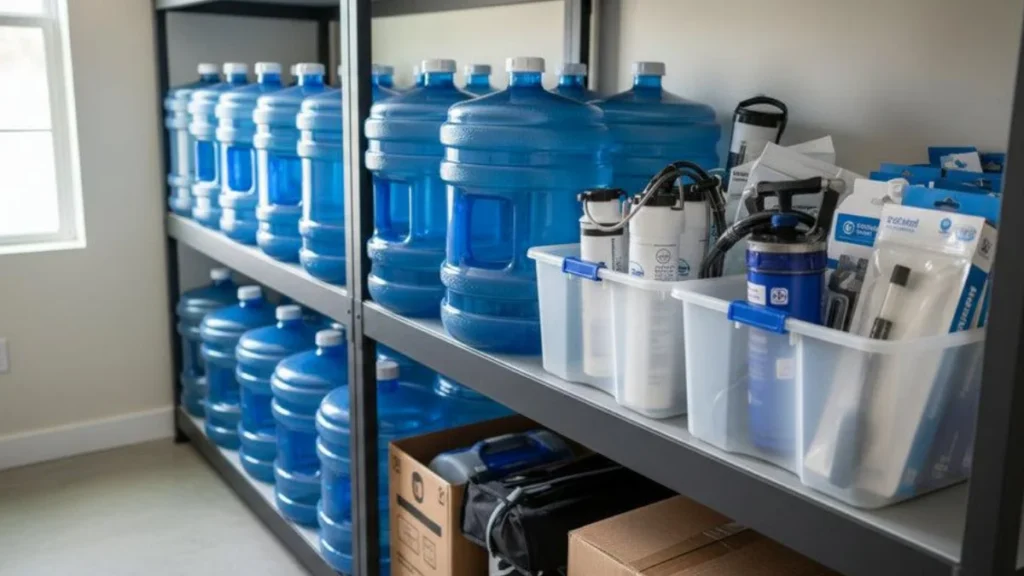
A widely used starting point for emergency water planning is at least one US gallon of water per person per day.
That is approximately 3.8 liters per person per day.
The U.S. Centers for Disease Control and Prevention (CDC) recommends storing at least one gallon per person per day for three days, with a two-week supply being preferable when possible.
This water is intended to help meet drinking and basic sanitation needs.
However, one gallon per person is a minimum planning guideline, not a guarantee that every household will have enough water in every situation.
People living in hot climates, individuals with certain health needs, and households with pets may require additional water.
Start building your family’s emergency plan with this complete beginner’s guide to household emergency preparedness.
Why Is One Gallon Per Person Recommended?
Water is needed for more than drinking.
During an emergency, households may also need safe water for:
- Preparing food and beverages
- Taking essential medications
- Basic personal hygiene
- Cleaning food-preparation items
- Certain medical or caregiving needs
Some of these activities can consume considerably more water than expected.
The one-gallon guideline provides a practical starting point, but it may not cover every household activity, especially if normal toilet flushing, bathing, or laundry becomes impossible.
For this reason, it is sensible to distinguish between a basic emergency drinking-water reserve and additional water for sanitation or other household needs.
The simplest approach is to establish your minimum supply first and then build an additional reserve based on your circumstances.
Emergency Water Storage Calculator: How Much Does Your Household Need?
Calculating your basic emergency water requirement is straightforward.
Multiply the number of people in your household by the number of days you want to prepare for.
Because the starting recommendation is one gallon per person per day, the calculation becomes:
Number of people × Number of days = Minimum gallons of emergency water
For example, a household of four preparing for seven days would need:
4 people × 7 days = 28 gallons
That is approximately 106 liters of water.
Emergency Water Requirements by Household Size
The following table provides a quick reference.
| Household size | 3-day supply | 7-day supply | 14-day supply |
|---|---|---|---|
| 1 person | 3 gallons | 7 gallons | 14 gallons |
| 2 people | 6 gallons | 14 gallons | 28 gallons |
| 3 people | 9 gallons | 21 gallons | 42 gallons |
| 4 people | 12 gallons | 28 gallons | 56 gallons |
| 5 people | 15 gallons | 35 gallons | 70 gallons |
| 6 people | 18 gallons | 42 gallons | 84 gallons |
These figures use the minimum planning quantity of one US gallon per person per day. They do not include additional allowances for pets, unusually hot conditions, or greater sanitation needs.
Example: Emergency Water Storage for a Family of Four
Suppose a family consists of two adults and two children.
Using the standard planning guideline:
- For three days, they need at least 12 gallons.
- For seven days, they need at least 28 gallons.
- For fourteen days, they need at least 56 gallons.
At first glance, 56 gallons may sound like an excessive amount of water to keep at home.
It is certainly a substantial quantity, particularly in a small apartment.
But the family doesn’t need to purchase the entire two-week supply immediately.
They could begin with 12 gallons, increase the reserve to 28 gallons over time, and eventually work toward a longer supply if their storage space and budget permit.
This gradual approach is often more manageable than trying to complete the entire preparation in one shopping trip.
Make sure your home is ready for unexpected situations with this practical emergency supplies checklist.
Remember the Weight of Stored Water
Water is heavy.
One US gallon weighs approximately 8.3 pounds (3.8 kilograms), excluding the container.
That means 28 gallons of water weighs roughly 233 pounds, while 56 gallons weighs about 467 pounds.
These figures matter when deciding where to store larger quantities.
Avoid placing heavy water containers on shelves or furniture that are not designed to support the load. In apartments or homes with limited storage, consider floor loading and seek appropriate guidance before concentrating a large reserve in one location.
Water storage should be practical and safe—not just about finding an empty corner.
Is a Three-Day Emergency Water Supply Enough?
A three-day supply is a useful starting point, but it should not automatically be treated as sufficient for every emergency.
The right amount depends on the disruptions most likely to affect your area and how long normal water services might remain unavailable.
A practical way to approach this question is to think in three stages.
Stage 1: Start With a Three-Day Water Supply
For a household with little or no emergency water stored, three days is a sensible starting goal.
It is relatively easy to calculate, and the required quantity is manageable for many households.
A three-day supply can help during shorter disruptions such as temporary water-main repairs, localized utility failures, or some severe-weather events.
However, emergencies do not always end within three days.
A major storm, flood, or infrastructure failure can cause interruptions that last much longer.
Think of the three-day supply as your first preparedness milestone, not your final target.
Stage 2: Build Toward Seven Days
Once your household has a reliable three-day reserve, consider expanding it to seven days.
A one-week supply provides additional flexibility if stores are closed, travel is restricted, or normal water services take longer than expected to return.
For a household of two people, this means 14 gallons.
For a family of four, it means 28 gallons.
Seven days is a practical intermediate target for households that want more protection but are not yet ready to store a full two-week reserve.
It is not a universal official requirement; it is simply a useful step between the initial three-day supply and a longer-term reserve.
Stage 3: Consider a Two-Week Reserve
The CDC recommends storing a two-week emergency water supply if possible.
This provides a larger margin for extended disruptions, particularly in areas where severe weather or infrastructure problems could delay service restoration.
For four people, a two-week supply amounts to 56 gallons under the one-gallon-per-person-per-day guideline.
That quantity requires more storage space, careful placement, and a plan for maintaining the water safely.
Not every household can store this amount immediately.
If space or cost is a constraint, don’t abandon emergency water storage altogether.
A smaller, properly maintained reserve is far more useful than a larger reserve that exists only on a shopping list.
How Should You Decide on Your Household’s Water Storage Target?
Before choosing a final quantity, consider the following questions:
- How many people live in your household? Count everyone who may depend on the supply.
- Are there pets? Include appropriate water for their needs.
- What emergencies are common locally? Hurricanes, floods, winter storms, extreme heat, and infrastructure failures can create different challenges.
- Does anyone have additional medical or personal water requirements? Consider these needs separately from the basic calculation.
- How much safe storage space is available? Large water reserves require adequate space and suitable support.
- What can your household reasonably afford? A gradual purchasing plan may be easier to maintain.
Your answers will help you establish a realistic target.
For many beginners, the most useful approach is to start with the recommended three-day minimum, expand toward one week, and then consider two weeks where practical.
Who Needs Extra Emergency Water?
The standard recommendation of one gallon per person per day is a useful starting point, but some households will need more.
Water requirements vary with age, health, climate, physical activity, and individual circumstances.
Households in Hot Climates
During extremely hot weather, the body loses more water through perspiration.
People who spend time outdoors or engage in physical activity may also need additional drinking water.
If your area regularly experiences high temperatures, don’t assume that the minimum emergency water recommendation will always be sufficient.
The CDC advises storing more water in hot climates and for pregnant or sick people.
Babies, Children, and People With Medical Needs
Households with infants should consider the water needed to safely prepare formula and clean feeding equipment.
People with certain medical conditions or equipment may also require additional water.
Discuss specialized water requirements with the relevant healthcare professional rather than relying entirely on a general emergency checklist.
Don’t Forget Pets
Pets depend on their owners for safe drinking water during emergencies.
Include them when planning your household reserve.
Water needs vary considerably between animals depending on species, size, diet, activity, and temperature.
For dogs and cats, consult your veterinarian if you are unsure how much additional water to store.
Additional Water for Sanitation
Drinking water is only part of the calculation.
During a prolonged interruption, households may need additional water for essential cleaning and sanitation.
Where practical, consider maintaining a separate supply for non-drinking uses.
However, clearly distinguish non-potable water from drinking water. Never use water of uncertain quality for drinking, food preparation, or other activities requiring potable water unless it has been appropriately treated and confirmed safe.
Growing some of your own food can be a practical introduction to self-sufficiency; our small backyard vegetable garden guide explains how to get started.
Best Containers for Emergency Water Storage
Choosing suitable containers is just as important as deciding how much water to store.
A good container should protect the water from contamination, withstand normal handling, and be easy to store and access.
For most beginners, two practical options stand out: commercially bottled water and properly maintained, food-grade storage containers.
Option 1: Commercially Bottled Water
Unopened commercially bottled water is generally the simplest option for starting an emergency supply.
It comes in sealed containers and doesn’t require you to fill or disinfect containers yourself.
Advantages include:
- Convenient for beginners
- Available in different bottle sizes
- Easy to distribute around the household
- No initial container preparation
- Suitable for gradually building a reserve
Keep bottles in their original sealed containers and follow the manufacturer’s storage instructions.
Inspect the packaging periodically and replace bottles that are damaged, leaking, or otherwise compromised.
Option 2: Refillable Food-Grade Water Containers
Reusable water containers may be more practical for households building larger reserves.
Look for containers specifically intended for drinking-water storage.
Ideally, they should have:
- Food-grade materials
- Tight-fitting lids
- Durable construction
- An opening that allows proper cleaning and filling
- A size that household members can handle safely
Containers with handles may be easier to move, although remember that even a five-gallon container holds more than 40 pounds of water.
Choose manageable sizes rather than assuming that the largest available container is automatically the best option.
Containers You Should Avoid
Never use containers that previously held toxic chemicals, pesticides, fuel, or other hazardous substances.
Such containers may remain unsafe even after washing.
Also avoid containers that are cracked, difficult to clean, or not suitable for drinking-water storage.
Ordinary household containers should not automatically be assumed safe for long-term water storage.
The safest beginner-friendly choice is commercially bottled water or a container specifically designed for potable water.
How to Store Emergency Water Safely
Safe storage begins before the water enters the container.
If you’re filling your own containers, use water from a safe drinking-water source and follow the CDC’s recommended cleaning and sanitizing procedures.
Do not fill drinking-water containers with water from a source known or suspected to be contaminated.
Clean and Sanitize Reusable Containers
Before filling a reusable container, wash it thoroughly with soap and water and rinse it completely.
The CDC recommends sanitizing suitable water-storage containers using a properly diluted solution of unscented household chlorine bleach containing 5%–9% sodium hypochlorite.
The procedure uses one teaspoon of bleach per quart (approximately one liter) of water as a container-sanitizing solution.
Close the container and shake it so the solution contacts all inside surfaces. After at least 30 seconds, pour out the solution and allow the container to air-dry or rinse it with safe water.
This is a container-sanitizing procedure, not a recipe for treating drinking water. Do not confuse the quantities used to disinfect containers with the much smaller quantities sometimes used to disinfect water itself.
Always check current CDC instructions before preparing sanitizing solutions, and never mix bleach with other cleaning chemicals.
Choose a Suitable Storage Location
Store emergency drinking water in a cool place away from direct sunlight.
Keep containers away from gasoline, pesticides, solvents, and other chemicals.
Avoid storage locations where flooding, excessive heat, physical damage, or contamination could affect the water.
A closet, suitable pantry area, or other clean indoor storage space may work well, depending on your home’s layout.
Place large containers on surfaces that can safely support their weight.
Label Self-Filled Containers
Mark reusable containers with the date they were filled.
This makes it easier to track when the water needs to be replaced.
If you maintain separate supplies of potable and non-potable water, label them clearly to prevent accidental use.
How Long Can Emergency Water Be Stored?
Water storage life depends on the source, container, filling method, and storage conditions.
Distinguish commercially bottled water from water you filled into reusable containers yourself.
Commercially Bottled Water
For commercially bottled water, follow the manufacturer’s storage instructions and any printed date information.
Keep the original seal intact until you need the water.
Inspect bottles for leaks, damage, or other signs that their integrity may have been compromised.
Properly sealed commercially bottled water is a convenient emergency option, but safe handling and storage remain important.
Water Stored in Reusable Containers
For water you fill into suitable containers yourself, the CDC recommends replacing it every six months.
Marking each container with the filling date makes this easier.
When replacing water, clean and sanitize reusable containers according to appropriate guidance before refilling them.
Create a Simple Water Rotation Schedule
You don’t need an elaborate inventory system.
A basic routine might be:
- Label each self-filled container with the date.
- Check containers during your regular emergency-supply review.
- Replace self-filled water at six-month intervals.
- Inspect commercially bottled water and follow its storage instructions.
- Replace damaged or questionable supplies.
A twice-yearly review can fit naturally into your household’s broader emergency preparedness routine.
What If Your Stored Emergency Water Runs Out?
Even a carefully planned water reserve can become insufficient during a prolonged emergency.
That is why it’s useful to understand possible backup water sources and the limitations of common water-treatment methods.
Follow Official Water Advisories
If local authorities issue a boil-water advisory, do-not-drink advisory, or do-not-use advisory, follow the specific instructions provided.
These advisories are not interchangeable.
Boiling can kill many disease-causing microorganisms, but it does not remove chemical contaminants, fuel, or radioactive materials.
If authorities warn that water contains hazardous chemicals or other contaminants that boiling cannot remove, boiling will not make it safe.
Can You Boil Water to Make It Safe?
When the concern is microbial contamination and boiling is an appropriate treatment, CDC guidance recommends bringing clear water to a rolling boil for one minute.
At elevations above 6,500 feet (approximately 2,000 meters), boil for three minutes.
If the water is cloudy, let particles settle first, or filter it through a clean cloth, paper towel, or coffee filter.
Allow boiled water to cool naturally and store it in a clean, sanitized container.
Again, boiling does not make chemically contaminated water safe.
Related: How to Store Drinking Water Safely for Emergencies: A Beginner’s Guide
What About Water Purification Tablets or Filters?
Some water filters and chemical disinfectants can help treat water under appropriate conditions.
However, different products remove or inactivate different contaminants.
A filter that improves taste or removes sediment may not remove viruses, and a chemical disinfectant may not remove harmful chemicals.
Follow the manufacturer’s instructions and official public-health guidance for the specific water source and suspected contamination.
Do not assume that an ordinary household pitcher filter can make floodwater or chemically contaminated water safe to drink.
Are There Other Emergency Water Sources at Home?
Depending on the circumstances, some homes may have additional water sources, but not all are suitable for drinking.
For example, water from a toilet tank, heating system, swimming pool, or other household fixture should not automatically be considered potable.
Water from flood-affected sources is particularly risky.
If your stored drinking water becomes unavailable, consult local emergency-management or public-health authorities for guidance on safe alternative sources and distribution points.
A reliable reserve of properly stored drinking water is preferable to depending on uncertain water sources during an emergency.
Emergency Water Storage in Apartments and Small Homes
Not everyone has a basement, garage, or large pantry for storing emergency supplies.
If you live in an apartment, condominium, or smaller home, finding space for several days of drinking water can be challenging.
Fortunately, effective emergency water storage doesn’t necessarily require a dedicated storage room.
The key is to use available space sensibly while keeping containers safe, accessible, and protected from damage.
Choose Smaller, Manageable Containers
Large water-storage barrels may work in some homes, but they aren’t always practical for apartments.
Smaller commercially bottled water containers or food-grade containers may be easier to accommodate.
For example, instead of storing all your water in one large container, you could distribute the supply among several smaller containers.
This also makes it easier to access water without lifting or moving a heavy barrel.
Remember that water is heavy. One US gallon weighs approximately 8.3 pounds, excluding the container.
Avoid stacking water on shelves or furniture that cannot safely support the weight.
Make Use of Existing Storage Space
Possible storage locations include:
- The bottom of a suitable pantry
- A cool, dry closet
- Low, accessible storage areas
- A designated utility or household storage space
- Other clean indoor locations protected from heat and chemicals
Avoid placing water containers where they could obstruct doors, hallways, emergency exits, or everyday movement.
If you live in a flood-prone area, avoid storing your entire drinking-water reserve where floodwater could reach it.
Likewise, do not place large quantities of water in one location without considering the structural load.
Keep a Small Supply Ready to Carry
Your main household water reserve is intended primarily for sheltering at home.
If an evacuation becomes necessary, you may not be able to transport large quantities.
Consider keeping a smaller amount of drinking water with your grab-and-go emergency supplies.
How much you can carry depends on household members’ abilities, transportation arrangements, and the circumstances of the evacuation.
The best storage arrangement protects your water while keeping it practical to use when needed.
How to Build an Emergency Water Supply on a Budget
One of the most common misconceptions about emergency preparedness is that you must buy everything immediately.
In reality, a household water reserve can be built gradually.
You do not need expensive storage systems to begin.
Step 1: Calculate Your Three-Day Minimum
Start with the basic calculation:
Number of people × 3 days × 1 gallon
For a family of four, that means at least 12 gallons.
This becomes your initial target.
If the household has additional water requirements, adjust the quantity accordingly.
Step 2: Buy Water Gradually
If your budget is limited, consider adding a manageable quantity of commercially bottled water during normal shopping trips.
For example, a household might purchase a few additional gallons each week until it reaches its initial target.
This spreads the expense rather than requiring one large purchase.
Choose packaging sizes that are easy to handle and store safely.
Step 3: Expand Toward Seven Days
Once you have established a reliable three-day supply, calculate the additional quantity required for one week.
For a household of four:
- Three-day minimum: 12 gallons
- Seven-day minimum: 28 gallons
- Additional quantity needed: 16 gallons
You can add this gradually while maintaining your existing reserve.
Step 4: Consider a Two-Week Supply
If your budget, available space, and household circumstances permit, work toward the CDC’s suggested two-week reserve.
Remember that a longer supply requires more storage space and greater attention to container condition and accessibility.
There is no benefit in buying more water than you can store safely.
Step 5: Maintain What You Have
A modest, properly maintained reserve is better than an impressive-looking collection of neglected containers.
Inspect your stored water periodically, follow the manufacturer’s instructions for commercially bottled water, and replace self-filled water every six months as recommended by the CDC.
Good maintenance helps protect the investment you have already made.
Common Emergency Water Storage Mistakes to Avoid
Emergency water storage is relatively straightforward, but several common mistakes can reduce its usefulness.
Mistake 1: Storing Too Little Water
A few bottles in the refrigerator may seem reassuring, but they may not provide enough water for even one full day.
Calculate your household’s needs instead of estimating by appearance.
Mistake 2: Forgetting Additional Household Needs
The standard one-gallon-per-person guideline is only a starting point.
Pets, hot weather, medical requirements, and additional sanitation needs may increase the amount required.
Mistake 3: Using Unsuitable Containers
Never use containers that previously held chemicals, fuel, or hazardous substances for drinking-water storage.
Choose commercially bottled water or suitable food-grade containers.
Mistake 4: Storing Water in Poor Conditions
Excessive heat, direct sunlight, chemical exposure, flooding, and physical damage can compromise storage conditions.
Choose a clean, protected location and inspect containers regularly.
Mistake 5: Forgetting to Rotate Self-Filled Water
Don’t forget water stored in reusable containers.
Label self-filled containers with the filling date and replace the water every six months, following CDC guidance.
Mistake 6: Assuming Every Water Filter Makes Water Safe
Different water-treatment methods address different contaminants.
Boiling can kill many microorganisms but does not remove chemical contamination.
Likewise, ordinary household filters may not remove pathogens or hazardous chemicals.
Always follow official water-safety advisories and use treatment methods appropriate to the suspected contamination.
Mistake 7: Making the Storage System Too Complicated
An elaborate water-storage arrangement may be difficult to maintain.
For beginners, a straightforward supply of properly stored drinking water is often the most practical solution.
Start with a manageable system and expand it only when necessary.
Emergency Water Storage Checklist
Before considering your emergency water preparations complete, review the following essentials.
- Calculate how many people depend on your household supply.
- Establish at least a three-day water reserve.
- Include additional water for pets and special requirements.
- Consider expanding toward seven days and eventually two weeks.
- Use commercially bottled water or suitable food-grade containers.
- Keep stored water away from direct sunlight, heat, and chemicals.
- Store containers where their weight can be safely supported.
- Label self-filled containers with the filling date.
- Replace self-filled water every six months.
- Inspect commercially bottled water and follow manufacturer guidance.
- Keep some water accessible for possible evacuation.
- Learn where to obtain official local water-safety information.
You don’t need to complete every step in one day.
This checklist makes your preparations measurable and manageable.
You don’t need to buy everything at once; our guide to building a home emergency kit on a budget explains how to prioritize essential supplies without overspending.
FAQ About How Much Emergency Water to Store
How much emergency water should a family of four store?
Using the minimum guideline of one US gallon per person per day, a family of four needs at least 12 gallons for three days, 28 gallons for seven days, or 56 gallons for fourteen days.
Additional water may be necessary for pets, hot weather, medical requirements, or greater sanitation needs.
Is three days of emergency water enough?
A three-day supply is a useful starting point, but longer disruptions may require additional reserves.
The CDC recommends storing at least three days of water and, if possible, building toward a two-week supply.
Your final target should reflect local hazards, household needs, available space, and budget.
Can I store tap water for emergencies?
Yes, if the tap water comes from a safe drinking-water source and is stored in a properly cleaned and sanitized food-grade container.
Follow CDC guidance for preparing containers, filling them safely, and replacing self-filled water every six months.
Do not store water from a source known or suspected to be contaminated.
How long does emergency bottled water last?
For unopened commercially bottled water, follow the manufacturer’s storage instructions and any printed date information.
Keep bottles properly sealed and protected from heat, chemicals, and physical damage.
Replace water stored in containers you fill yourself every six months, per CDC guidance.
What is the cheapest way to store emergency drinking water?
For many households, the simplest affordable approach is to build a reserve gradually using commercially bottled water or suitable reusable food-grade containers.
Begin with a three-day minimum and expand as your budget and storage space allow.
Avoid purchasing specialized equipment before establishing your basic drinking-water supply.
Conclusion: Start Small, Store Safely, and Build Gradually
Emergency water storage is one of the simplest and most valuable steps you can take to prepare your household.
You don’t need expensive equipment, a large storage room, or a complicated system to get started.
Begin by calculating your household’s minimum needs using one gallon per person per day.
Aim for at least three days, consider expanding to one week, and work toward a two-week reserve if practical.
Choose suitable containers, store water safely, and maintain your supply through periodic checks and rotation.
Most importantly, make your plan realistic.
A household that keeps a modest, reliable supply of drinking water is better prepared for a temporary disruption than one that has made ambitious plans but never begun storing water.
Start with your first three days of water. Once that foundation is in place, build from there.
For a broader approach to protecting your household during disruptions, read our Household Emergency Preparedness: A Complete Beginner’s Guide.
You can also consult our Emergency Supplies Checklist: What Every Home Should Have to make sure your water reserve is supported by food, lighting, first aid, communication, and other essential supplies.
Preparedness doesn’t happen all at once. It develops through small, practical steps that make everyday life more resilient.
Related: How to Store Drinking Water Safely for Emergencies: A Beginner’s Guide