Growing your own vegetables doesn’t require a large backyard, expensive equipment, or years of gardening experience. With a sunny patch of ground, a few basic tools, and a little patience, you can begin producing fresh food right outside your home.
A small backyard vegetable garden is one of the most practical ways to introduce self-sufficiency into everyday life. It helps you understand where food comes from, build useful household skills, and enjoy fresh produce you grew yourself.
The key is to start small and build your confidence gradually.
This beginner-friendly guide explains how to choose a suitable location, prepare the soil, select easy vegetables, plan your planting season, and maintain your first garden without unnecessary expense.
Why Start a Small Backyard Vegetable Garden?
A home vegetable garden offers benefits beyond the vegetables you harvest.
Fresh food close to home: You can harvest leafy greens, herbs, tomatoes, and other vegetables when they are ready to eat.
Practical self-sufficiency: Gardening teaches valuable skills such as starting seeds, managing soil, watering, composting, and seasonal food production.
Read our guide to How to Start Composting at Home for Beginners
Better use of household resources: Kitchen scraps and garden waste can be turned into useful compost instead of being discarded.
An enjoyable outdoor activity: Gardening encourages regular time outdoors and gives family members opportunities to learn together.
Potential grocery savings: Growing vegetables you frequently purchase may reduce some food expenses, although initial costs, growing conditions, and harvest success all affect the actual savings.
A small garden will not make most households completely food-independent. However, it can become a useful first step toward a more resourceful and resilient home.
Step 1: Choose the Best Location for Your Garden
Before buying seeds or gardening tools, spend some time observing your backyard.
The location you choose will influence how well your vegetables grow.
Look for adequate sunlight
Most vegetables grow best with at least six hours of direct sunlight daily. Tomatoes, peppers, and many other fruit-producing crops generally perform better with eight or more hours.
Observe your yard during the morning, midday, and afternoon. Buildings, fences, and trees can create shade that changes throughout the day.
If your available space receives only partial sunlight, consider leafy vegetables such as lettuce, spinach, or Swiss chard, which may tolerate somewhat less sunlight than tomatoes or peppers.
Choose well-drained ground
Vegetable roots need both moisture and oxygen.
Avoid areas where water remains pooled after rainfall. Poor drainage can damage roots and encourage plant diseases.
A relatively level area with loose, well-drained soil is usually easier for beginners to manage.
Keep the garden close to water
Choose a location within convenient reach of a hose or watering can.
Vegetables require regular attention, particularly during hot or dry weather. A garden that is difficult to access may become unnecessarily demanding.
Also avoid planting near large trees, where roots compete for moisture and nutrients.
Beginner tip: Choose the most suitable sunny location rather than automatically selecting the largest available space.
Step 2: Decide How Much Space You Need
One of the most common beginner mistakes is starting with a garden that is too large.
A small, well-maintained garden is generally more rewarding than a large garden that becomes difficult to manage.
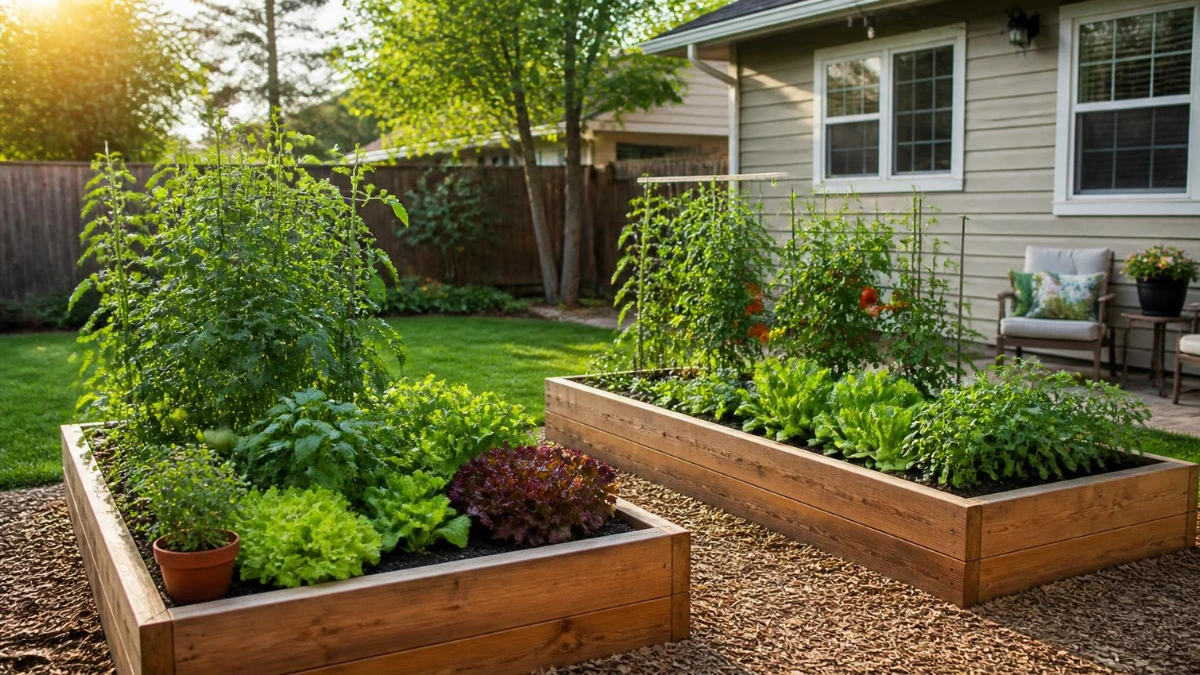
For a first project, consider one raised bed measuring approximately 4 × 8 feet, a small in-ground plot, or several large containers.
A 4 × 8-foot bed provides 32 square feet of growing space. That is enough to learn the basics and grow a modest selection of vegetables, although it will not supply all the produce a household needs.
Three practical options
| Garden type | Advantages | Considerations |
|---|---|---|
| In-ground garden | Usually less expensive if the existing soil is suitable | May require soil improvement and weed management |
| Raised bed | Easier to define growing space and manage soil | Requires materials and additional soil |
| Container garden | Suitable for patios and very small yards | Containers may dry out quickly |
For most beginners with usable backyard soil, an in-ground garden is the least expensive starting point.
Raised beds can be particularly useful where soil quality or drainage needs improvement.
Containers are a good alternative for households with limited outdoor space.
Step 3: Prepare the Soil Before Planting

Healthy soil is a foundation of successful vegetable gardening.
Vegetables need soil that provides nutrients, holds adequate moisture, and allows excess water to drain away.
Check the existing soil
Examine your proposed garden area.
Is the soil compacted? Does it contain many stones? Does water drain reasonably well?
A laboratory soil test can identify nutrient levels, soil pH, and any needed amendments. Local cooperative extension services in the United States and provincial or regional gardening resources in Canada can help with testing information.
If your property has a history of industrial use, contaminated fill, or possible lead exposure, consider appropriate contaminant testing before growing edible crops.
Improve soil with compost
Finished compost can improve soil structure and contribute organic matter.
Spread a modest layer of mature compost over the garden area and incorporate it where appropriate, following local soil-test recommendations.
Avoid assuming that more fertilizer is always better. Excess nutrients can harm plants and contribute to environmental problems.
Never use unfinished manure or questionable waste materials without understanding their food-safety risks.
Prepare the planting surface
Remove persistent weeds, unwanted debris, and large stones.
Loosen compacted soil where necessary, but avoid working soil when it is extremely wet.
Level the planting area and leave enough space to reach the plants without repeatedly stepping on the growing medium.
For raised beds, use materials suitable for food gardening and fill them with an appropriate growing medium.
Practical advice: Good soil preparation often produces better results than purchasing expensive gardening accessories.
Step 4: Choose Easy Vegetables for Beginners
Not every vegetable requires the same amount of space, sunlight, or attention.
For your first growing season, choose three or four crops that your household enjoys eating.
Here are several beginner-friendly options.
| Vegetable | Why consider it? | Growing season |
|---|---|---|
| Lettuce | Compact and suitable for repeated small harvests | Cool season |
| Radishes | Quick-growing and useful for learning seed planting | Cool season |
| Bush beans | Productive without tall climbing supports | Warm season |
| Swiss chard | Harvestable leafy greens | Cool to mild weather |
| Cherry tomatoes | Useful harvests from a small number of plants | Warm season |
| Zucchini | Can produce generously | Warm season; needs considerable space |
| Kale | Tolerates cool conditions | Cool season |
| Green onions | Can fit into smaller spaces | Cool to mild weather |
Planting dates and suitability vary by local climate and variety.
Start with vegetables you actually eat

Growing ten different crops may sound exciting, but it also creates ten different sets of care requirements.
A simpler approach is to grow lettuce, bush beans, one cherry tomato plant, and a few herbs, provided the season and available space suit those crops.
This offers a manageable introduction to different plant types.
Step 5: Understand Your Local Growing Season
The right planting date depends heavily on where you live.
A gardener in southern Florida faces very different conditions from someone in Minnesota, Alberta, or Nova Scotia.
Know your frost dates
Your area’s average last spring frost and first autumn frost help estimate the outdoor growing season.
Cool-season crops, such as lettuce and radishes, can often be planted earlier than frost-sensitive vegetables.
Warm-season crops, such as tomatoes and peppers, generally need warmer soil and protection from freezing temperatures.
Remember that average frost dates are estimates, not guarantees.
Understand hardiness zones
USDA plant hardiness zones in the United States and Canadian plant hardiness information can help gardeners understand regional climate conditions, particularly for perennial plants.
For annual vegetables, however, frost dates, soil temperature, growing-season length, and local weather are especially important.
Useful resources include:
- USDA Plant Hardiness Zone Map: https://planthardiness.ars.usda.gov/
- Natural Resources Canada’s Plant Hardiness website: https://planthardiness.gc.ca/
- Local university extension services and regional planting calendars.
Follow seed-packet instructions
Seed packets normally provide information about planting depth, spacing, germination, and expected maturity.
Some crops grow well when seeds are planted directly outdoors. Others, including tomatoes in many northern climates, are often started indoors or purchased as seedlings.
Use regional planting recommendations rather than assuming the same calendar works across North America.
Step 6: Plan Your First Garden Layout
A simple layout can make planting, watering, weeding, and harvesting easier.
Consider a 4 × 8-foot raised bed.
You might dedicate one area to lettuce and radishes, another to bush beans, and another to Swiss chard.
If you want to grow tomatoes, check the mature size of the variety you choose. A tomato plant can take up a lot of space and may need a cage or stake.
Avoid overcrowding.
Seedlings may look small at first, but their mature leaves and roots need room to develop.
Place taller plants where they won’t unnecessarily shade shorter vegetables. In much of the Northern Hemisphere, the northern side of the garden is often suitable for taller crops, depending on nearby structures and sunlight.
You can also grow herbs in separate containers to preserve valuable bed space.
Beginner tip: Draw a simple garden plan on paper before purchasing plants. It is much easier to adjust a drawing than to relocate established vegetables.
Step 7: Plant Seeds and Seedlings Correctly
Once your soil is prepared and the season is suitable, you can begin planting.
Planting seeds
Follow the seed packet’s instructions for depth and spacing.
As a general rule, planting seeds too deeply can prevent successful emergence, particularly for small seeds.
After sowing, water gently so the soil settles around the seeds without washing them away.
Keep the seedbed consistently moist during germination, but avoid waterlogging.
When seedlings develop, thin crowded plants according to the recommended spacing.
Planting seedlings
Purchased seedlings can simplify gardening for beginners, especially for tomatoes and peppers.
Choose healthy plants with sturdy stems and no obvious signs of disease or insect damage.
Before moving indoor-grown seedlings outdoors permanently, gradually expose them to outdoor sunlight, wind, and temperatures. This process is called hardening off.
Plant according to the crop’s recommended depth, water thoroughly, and monitor the plants as they become established.
Step 8: Water Your Vegetable Garden Properly

Vegetables need adequate moisture to develop healthy roots, leaves, and harvestable produce.
However, overwatering can be just as harmful as underwatering.
A common starting guideline for established vegetable gardens is about 1 inch of water per week, including rainfall, though actual needs vary with weather, soil, crop type, and growth stage.
Containers may require more frequent watering.
Simple watering practices
Check the soil before watering rather than relying only on a fixed schedule.
Water near the base of plants so moisture reaches the root zone.
When possible, water early in the day and avoid leaving foliage wet for extended periods.
Apply water slowly enough for it to soak into the soil rather than run off.
Mulching with suitable organic materials can help reduce evaporation, moderate soil temperature, and suppress weeds.
New seedlings and recently transplanted vegetables may require closer attention than established plants.
Step 9: Manage Weeds, Pests, and Common Problems
Even a carefully planned garden will encounter occasional problems.
The best approach is regular observation and early action.
Control weeds while they are small
Weeds compete with vegetables for water, sunlight, and nutrients.
Remove them before they become established or produce seeds.
A light layer of appropriate mulch can reduce weed growth and simplify maintenance.
Inspect plants regularly
Look beneath leaves and around stems for insects, discoloration, or signs of damage.
Not every insect is harmful. Many insects contribute to pollination or help control pests.
Identify the problem before applying any treatment.
If intervention becomes necessary, prioritize appropriate nonchemical measures and follow reliable local extension guidance. Any pesticide used on edible crops must be specifically permitted for that use, and label directions must be followed carefully.
Avoid the most common mistakes
Too much planting: An oversized garden can become overwhelming.
Insufficient sunlight: Vegetables may grow weakly or produce disappointing harvests.
Overwatering: Saturated soil can damage roots.
Poor spacing: Crowded plants may compete for resources and have inadequate airflow.
Ignoring seasonal conditions: Planting frost-sensitive vegetables too early can result in crop loss.
Expecting immediate results: Gardening requires patience and occasional experimentation.
A failed planting is an opportunity to improve your approach for the next season.
Step 10: Harvest and Make the Most of Your Vegetables
Harvesting is one of the most satisfying parts of growing food.
Different crops require different harvesting methods.
Leaf lettuce and Swiss chard may allow repeated harvests of suitable outer leaves.
Radishes are generally harvested when roots reach the recommended size.
Pick bush beans while pods are tender, before seeds become overly mature.
Harvest tomatoes based on ripeness and intended use.
Check the variety’s seed packet or plant label for specific guidance.
Use what you harvest
Plan meals around vegetables that are ready to pick.
Wash produce under clean running water before preparing or eating it.
Refrigerate perishable vegetables promptly and follow appropriate food-storage practices.
If your garden produces more than your household can use immediately, consider sharing the surplus, freezing suitable produce, or learning safe preservation methods from research-based sources.
Avoid using untested home-canning recipes, particularly for low-acid vegetables.
A Simple First-Month Vegetable Gardening Plan
You do not need to complete every gardening task in one weekend.
A four-week plan can make the project more manageable.
| Week | Main activities |
|---|---|
| Week 1 | Observe sunlight, choose a location, measure the area, and check local planting dates |
| Week 2 | Test or assess soil, prepare the bed, and choose suitable crops |
| Week 3 | Purchase seeds or seedlings and plant according to local conditions |
| Week 4 | Monitor watering, check germination and plant health, and remove small weeds |
This schedule is flexible. Soil testing, seed starting, and seasonal weather may require additional time.
If the weather is unsuitable for outdoor planting, use the month for planning and preparation instead.
How Much Does a Small Backyard Vegetable Garden Cost?
The cost depends on the garden type, soil conditions, and the materials and tools you already have.
An in-ground garden can be relatively inexpensive if the soil is suitable and you already own basic tools.
A raised bed usually costs more initially because it requires construction materials and additional soil.
Common expenses include seeds, seedlings, compost, soil testing, a hand trowel, watering equipment, and optional supports.
You can control costs by starting with a single small bed, borrowing tools, reusing suitable containers, and buying only the supplies you need for your first few crops.
Avoid buying large gardening kits before you understand what your garden actually requires.
View your first season primarily as an investment in learning rather than a guaranteed source of grocery savings.
How Vegetable Gardening Supports Household Self-Sufficiency
A small garden will not replace a complete household food supply.
Nevertheless, it can improve your understanding of food production and help you build useful practical skills.
Over time, you may learn to save suitable seeds, improve soil with compost, extend your growing season, and safely preserve excess harvests.
These skills complement other aspects of household resilience, including emergency food storage, water planning, and reducing avoidable waste.
The most sustainable approach is gradual progress: start with a manageable garden, learn what works in your climate, and expand only when you are ready.
Building a useful emergency pantry starts with understanding what food to store for emergencies and how much your household may need.
If your family is preparing for a prolonged disruption, understanding your household’s emergency water needs is an important first step.
Frequently Asked Questions
Can I grow vegetables in a very small backyard?
Yes. A small raised bed, in-ground plot, or collection of containers can support vegetables such as lettuce, herbs, radishes, and compact tomato varieties. Choose plants according to available sunlight and space.
What is the easiest vegetable to grow for beginners?
Radishes, lettuce, bush beans, and Swiss chard are commonly recommended beginner crops. The easiest choice depends on your local growing season and weather conditions.
Do I need raised beds to grow vegetables?
No. Vegetables can grow successfully in ordinary garden soil if drainage, fertility, sunlight, and soil safety are suitable. Raised beds are an option, not a requirement.
How much sunlight does a vegetable garden need?
Most vegetables benefit from at least six hours of direct sunlight daily. Fruit-producing vegetables such as tomatoes generally perform better with more sunlight.
Can I start a vegetable garden in autumn?
Yes, depending on your climate. Many regions support autumn crops such as lettuce, kale, and radishes. In colder areas, outdoor planting opportunities become more limited as frost approaches.
Is vegetable gardening worth the effort?
For many households, gardening provides fresh produce, outdoor activity, practical learning, and greater familiarity with food production. Financial savings are possible but depend on growing costs and harvest success.
Final Thoughts
Starting a small backyard vegetable garden is a practical way to build everyday self-sufficiency without major lifestyle changes.
You do not need perfect soil, expensive equipment, or a large property.
Start with a sunny space, choose a few vegetables that match your climate, and learn the basics of planting, watering, and harvesting.
Your first garden may not produce everything you hope for. That is normal.
What matters is developing the knowledge and confidence to improve each season.
Start with one small growing space and a few manageable crops. A more resilient home can begin with something as simple as planting your first vegetable seeds.
For a short Further Reading, these are particularly useful:
- University of Maryland Extension — How to Start a Vegetable Garden (updated February 2026).
University of Maryland Extension
- University of Wisconsin Extension — Site Selection and Soil Preparation.
Wisconsin Horticulture
- NC State Extension — Vegetable Gardening Guide.
NC State Extension Publications
- Natural Resources Canada — Plant Hardiness Information.
Natural Resources Canada